Buying the casket somewhere else, and what to check before the truck arrives
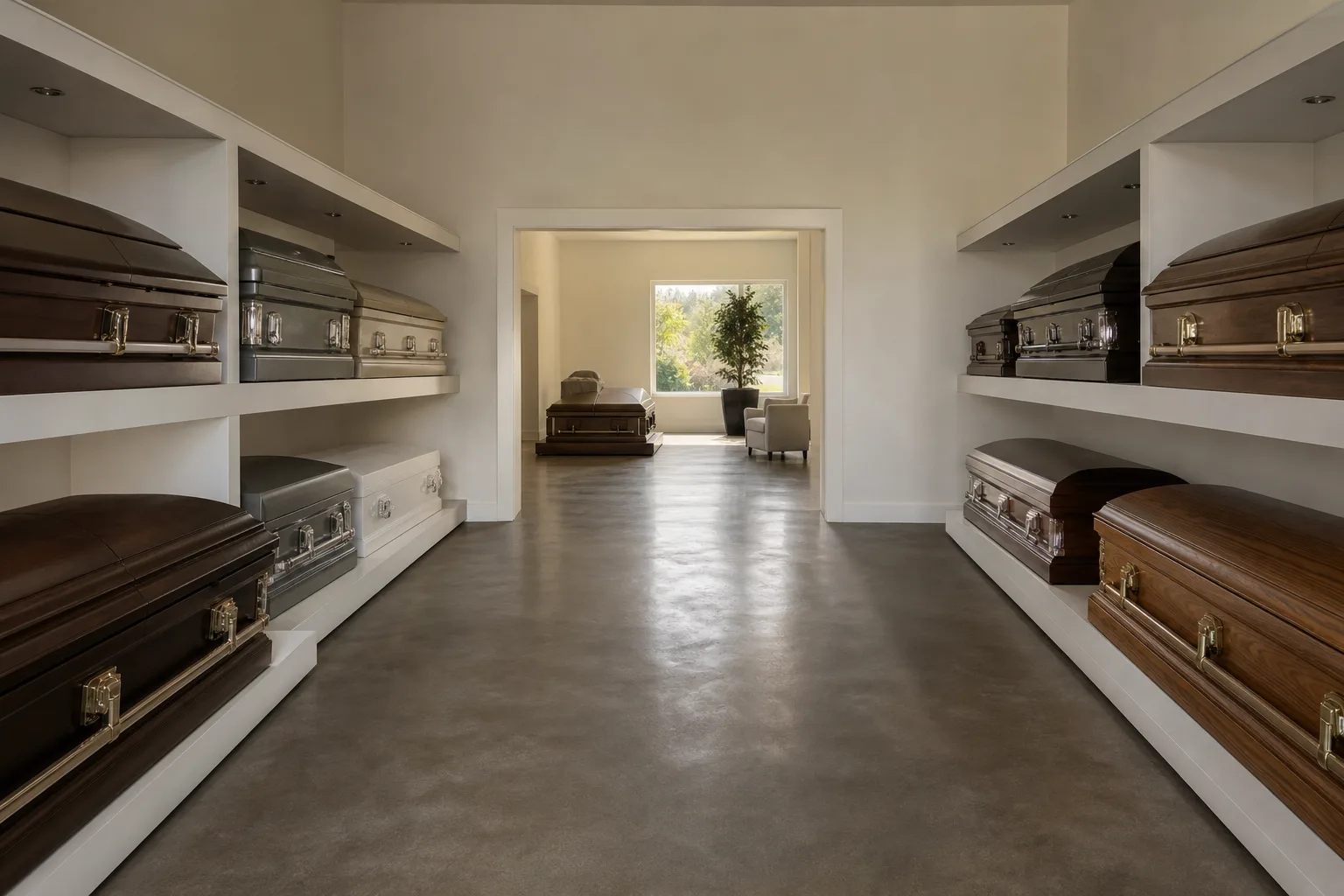
Cemeteries are separate. The Funeral Rule governs funeral providers, not cemeteries. A cemetery's own rules about liners, vault sizes and graveside equipment still apply and have to be checked directly with its office.
Standard interior dimensions. Most manufactured adult caskets run near seventy-eight inches long and roughly twenty-four inches wide inside. Grave liners and vaults are built to accommodate that footprint, which is why an unusually wide homemade box can be refused.
Freight delivery windows. Caskets ship crated on pallets and arrive within a carrier's business-day window, not at a set hour. Someone with a dock or a hand truck has to be there to receive it.
| Item | What it means |
|---|---|
| Regional warehouse stock | Some online sellers keep inventory in regional warehouses and can deliver within a day inside a metro area. Ask which warehouse your model ships from before you order. |
| Warehouse club catalogs | Club retailers usually list a small number of models rather than a full range. The narrow selection is the trade-off for the price and the simple ordering process. |
| Paying a woodworker | A local builder prices by lumber and hours, so a simple butt-jointed pine box and a dovetailed hardwood one differ enormously. Ask for a written quote covering finish, hardware and a delivery date. |
A casket is the one item on a funeral home's price list that a family can legally buy somewhere else and bring with them, and the savings are usually large enough to be worth the trouble of arranging it. The trouble is real, though, and it is mostly about timing rather than money. A box that arrives the morning after the service is worth nothing. What follows are the five checks that decide whether an outside purchase works, taken in the order a buyer actually faces them.
1. What the Funeral Rule settles before you start negotiating
The Federal Trade Commission is responsible for the Funeral Rule, the trade regulation that governs how funeral providers quote and sell. Two of its provisions matter here. A funeral home must accept a casket or alternative container a family obtained elsewhere, and it may not charge a handling fee, a receiving fee, or a surcharge of any name for doing so. It also may not condition its services on your buying the casket from its own selection room. You do not need to argue this point or cite anything; simply say the container is coming from an outside seller and ask where the carrier should deliver it.
2. What the price difference between sellers actually reflects
Third-party casket retailers, most of them selling online and shipping by freight, usually price well below a funeral home's selection room for a comparable steel or hardwood model, because they carry no facility, no staff on call, and no obligation to stock a full range in one building. Warehouse clubs sit in a similar range with a narrower catalog. A local woodworker prices by labor and lumber instead, so a plain pine or poplar box can land anywhere from very cheap to more than a manufactured casket, depending on joinery and finish. Ask each seller for the model's exterior dimensions, gauge or wood species, and shipping weight in writing.
3. How delivery timing works, and who signs for the crate
This is where outside purchases fail. Freight carriers deliver on business days within a window, not at an appointed hour, and a casket travels crated on a pallet that one person cannot unload. Before ordering, confirm three things: the seller's cutoff for same-day shipment, whether the shipment moves by air or by ground, and whether the funeral home has someone on site to receive and sign for it. Some sellers keep regional warehouses and can deliver overnight or the same day within a metropolitan area. Get the promised delivery date and the tracking number, then tell the funeral director both.
4. The measurements a homemade box has to satisfy
A box built in a home shop has to fit three things it did not design itself. Standard manufactured caskets run roughly seventy-eight inches long and about twenty-four inches wide at the interior, and cemetery vaults and grave liners are sized to that norm, so a wider box may not drop into a standard liner. A crematory retort has its own width and weight limits. The lowering device at graveside has fixed rail spacing. Call the cemetery office and the crematory, give them your exterior length, width and height, and write down the numbers they give you back.
5. Bottom, handles and the weight the box will really carry
The two structural questions are the floor and the hardware. The bottom must be rigid enough that the box can be lifted, carried and set on a church truck without flexing, which in practice means a solid panel or thick plywood fastened to a frame rather than boards laid loose. Handles, whether rope, wood cleats or bar hardware, need to be through-bolted or screwed into that frame, not into thin side panels, and spaced so three bearers can stand comfortably on each side. Ask the funeral director to inspect the finished box a day early.
The families who do this successfully treat the container as a logistics problem with a delivery date attached, not a shopping decision. Order early, put the address and the arrival date in the funeral director's hands, and confirm the dimensions with the cemetery before a single board is cut.