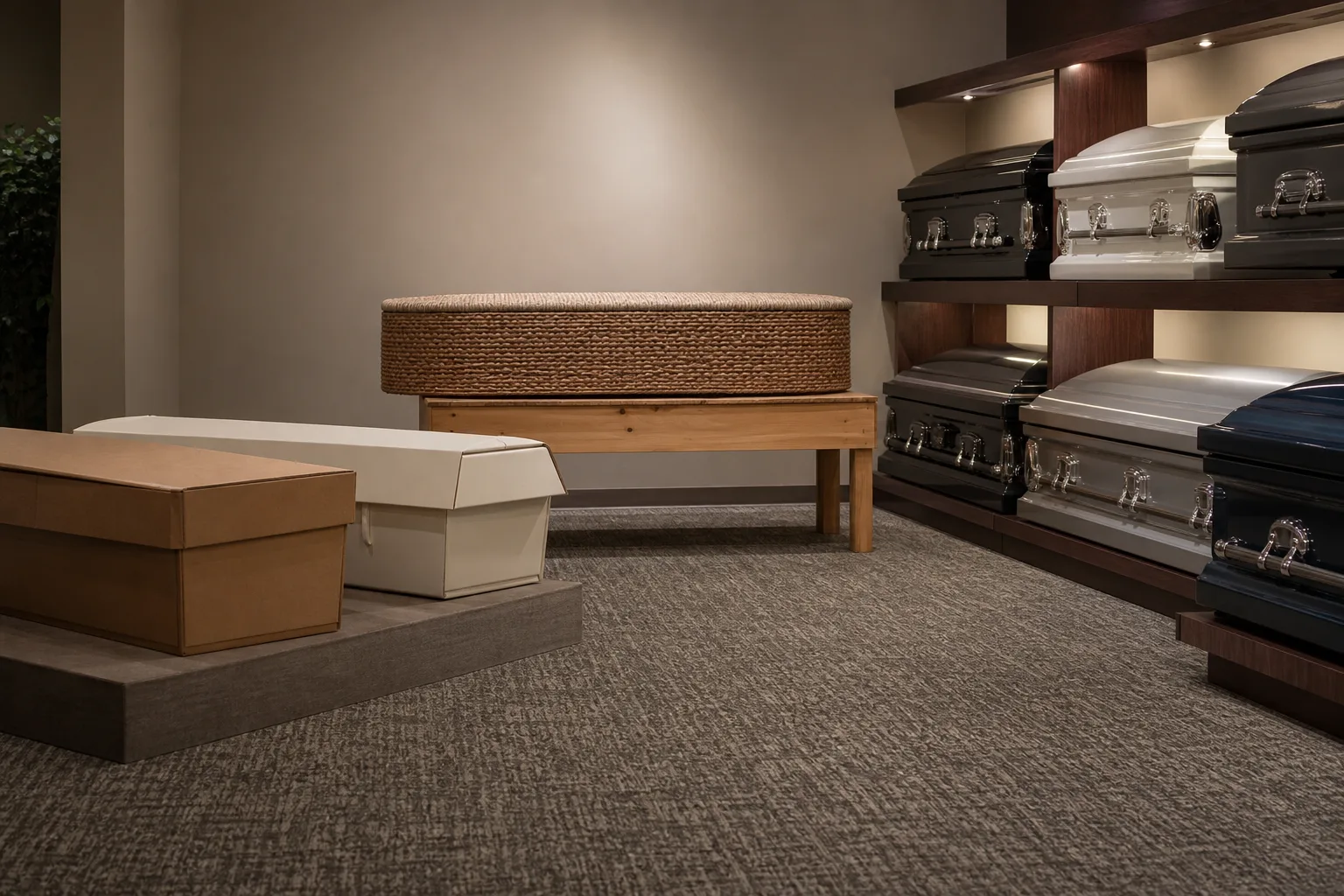
The container is a single line on the itemized statement a funeral provider hands you, and it can be decided on its own, apart from the embalming, the staff time, the transfer, the visitation, and everything else on that page. That separation matters, because the container is where the price spread is widest. Two families using the same funeral home for the same service can differ by ten thousand dollars on this one line, and nothing else on either statement will change. Understanding what actually differs between the boxes is the fastest way to control the total.
Why the container sits on its own line
Funeral providers in the United States are required to give you an itemized price list, and the casket or alternative container appears there as a separate charge rather than as part of a package. The Federal Trade Commission is the agency responsible for how funeral goods and services are priced and disclosed to consumers, and the itemization exists so that families can compare one item at a time. Practically, this means you may choose the least expensive container in the room and still have the service you planned, with the same staff, the same chapel, and the same cars.
The second consequence of itemization is that the container is portable between decisions. A family can select a service at one funeral home and buy the container elsewhere, or select a modest container now and spend the difference on something that will last longer, such as the marker. Nothing about the service is bundled into the box.
The bottom of the range: alternative containers
An alternative container is a rigid, unadorned box built to hold and transport a body, usually corrugated fiberboard, pressed wood, or unfinished softwood. It has no handles you would want to carry with, no interior lining beyond a simple pad, and no finish. These are the containers used for direct cremation and for burials where the family does not want a display piece, and they typically run from under a hundred dollars to a few hundred, depending on the material and the region. A cloth-covered fiberboard box with a fitted lid sits at the top of this group and photographs far better than most families expect.
One step above that is the plain wooden box: pine, poplar, or fir, joined with simple hardware, sometimes unfinished and sometimes lightly sealed. Kosher and green burial grounds often require exactly this construction, with no metal at all. Price bands here usually begin in the high hundreds and reach into the low thousands for careful joinery and a hardwood species.
The middle: veneer, hardwood, and steel by gauge
Most of what stands on a selection room floor lives in the middle, and the middle is where the vocabulary starts to matter. Wooden caskets are priced by species and by whether the panels are solid or veneered, with poplar and oak at the lower end, maple and cherry in the middle, and mahogany, walnut, and cabinet-grade cuts at the top. Steel caskets are priced by gauge, which is a thickness measure that runs backward: 20 gauge is thinner than 18, and 18 is thinner than 16. Each step down in gauge number adds metal, weight, and a few hundred dollars.
Interiors move independently of the shell. Crepe, twill, velvet, and satin cost progressively more, and adjustable beds, memory drawers, and embroidered head panels are add-ons a manufacturer prices into the model rather than sells separately. Catalogs sometimes separate the traditional shapes from the rectangular ones, listing a Coffin as its own category alongside standard caskets. Across this whole middle band, from a veneered hardwood to a 16 gauge steel with a full velvet interior, retail prices commonly run from roughly one thousand to five or six thousand dollars, with wide regional variation.
The top: stainless, copper, and bronze
Above steel sit stainless steel, copper, and bronze, and these are priced by the metal itself. Copper and bronze are sold by weight per square foot rather than by gauge, and because neither corrodes the way carbon steel does, manufacturers position them as the most durable shells they build. A sealed bronze casket with a premium interior is the most expensive item most families will ever be shown at a funeral home, generally running from the high four figures well into five, and it is where the entire range tops out.
What the extra money buys is material and finish: more metal, a hand-rubbed or brushed surface, heavier hardware, and a gasket and locking mechanism intended to resist water entry. None of that changes what the cemetery requires, and none of it changes the service. It is a purchase about material quality, and it is reasonable to treat it that way.
Reading the spread before you choose
Ask for the full price list rather than a tour of the room, because selection rooms are arranged to put mid and upper models at eye level and the least expensive ones in a corner or in a photograph binder. Then set the range you are willing to spend before you look at anything, and let the list, not the display, tell you what falls inside it. Every model between the fiberboard box and the bronze does the same job on the day. The rest is material, finish, and how much of the budget you want that line to hold.
Take the itemized statement home if you can, and read the container line beside the others. It is the one number on the page that you can move by several thousand dollars in either direction without changing anything a guest will see, which makes it the most useful place to start.